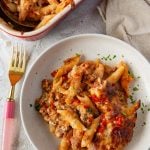
Baked ziti
If it's good enough for the Sopranos, it's good enough for me
Servings: 8
Ingredients
- 2 garlic bulbs
- 500 g penne pasta 1 pound
- 500 g beef mince 1 pound
- 250 g lamb mince 1/2 pound
- 250 g pork mince 1/2 pound
- 5 tbsp olive oil
- 2 white onions finely diced
- 2 carrots peeled and finely diced
- 2 celery stalks finely diced
- 4 garlic cloves crushed
- 2 tbsp tomato paste
- 3/4 cup white wine
- 700 g passata/tomato puree
- 4 over ripe tomatoes peeled and diced
- 1 cup water 250mL
- 1 tbsp dried oregano
- 2 bay leaves
- 2 tbsp brown sugar optional
- 400 g ricotta
- 50 g mozzarella cheese +30g extra, grated
- 50 g parmesan grated
- 2 tbsp finely diced parsley
- 1 tsp nutmeg
- 1 egg
- sea salt + black epper
Instructions
- To make the ragu bolognese, take 1 – 2 tablespoons of the mice and roll them into a ball in the palm of your hand. Season the mince with salt and pepper on both sides.
- Add 2 tablespoons of the olive oil to a large saucepan over high heat. Once hot, add half the mince to the pan, flatten with your hand or a spoon and fry for 3 minutes, ensuring you do not touch it. You want it to be caramelised and brown on one side. Flip the mince over and cook for a further 2 minutes until a crust forms on the other side. Break the mince up with a whisk or wooden spoon and give it a quick stir through. Take the mince out of the pan with all of its juices and transfer to a bowl. Drizzle the pan with another tablespoon of olive oil and repeat with the remaining meat. Don’t worry if the meat is still a little pink and not cooked through as it will continue to cook once in the sauce. This step ensures we build flavour and texture in the dish.
- To the same pan, add another 2 tablespoons of the olive oil. Once there is a slight haze and sizzle coming the pan, turn the heat down to medium–low and cook the onion, carrot and celery for 10 minutes, or until they become fragrant and translucent. Add the fresh crushed garlic to the pan and cook for 3 minutes.
- Turn the heat to high and add the tomato paste to the pan. Cook for 3 minutes, stirring quite often, until it turns a deep-red colour and is almost sticking to the pan. Deglaze the pan with the white wine and stir for 2 minutes or until 80 per cent of the liquid has evaporated.
- Add the passata, fresh tomato, 250 ml (1 cup) of water, the bay leaves, dried oregano, a generous amount of salt and pepper and the sugar (if using) to the pan and stir well. Add the mince and all of its delicious juices and give it a stir. Bring the ragu to the boil, then reduce the heat to low and leave to simmer for 2 ½ - 3 hours with the lid off. Taste the sauce as it cooks to ensure it is seasoned to your liking. You may want to add more sugar, salt or pepper.
- While the sauce cooks, preheat the oven to 160 degrees C / 320 degrees F if making the roasted garlic. You can always replace the roasted garlic with 4 cloves of fresh garlic that has been finely diced.
- Using a sharp knife, slice the top off the garlic bulb, about 2 – 3 cm down from the top to expose the raw cloves. Place the bulb of garlic into the centre of an oven proof dish, drizzle with olive oil and season with salt and pepper. Bake for 1 hour.
- Allow the garlic to slightly cool until you are able to handle it. Using your fingers, squeeze the roasted garlic cloves out of their skin. Set to the side.
- Prepare the ricotta sauce by combining the ricotta, mozzarella, parmesan, parsley, nutmeg, roasted garlic, egg and big pinch of salt and pepper to a bowl. Mix until smooth and well combined. Set to the side.
- When you are ready to prepare the baked ziti, preheat the oven to 180C/350F
- Bring a large saucepan of heavily salted water to the boil. Follow the instructions on the packet and drain your pasta 2 minutes before the suggested cooking time. Reserve 125–250 ml (1⁄2–1 cup) of the pasta cooking water.
- Remove up to 2 cups of the ragu Bolognese sauce and set to the side.
- Combine your drained pasta and the reserved pasta water with the remaining sauce in the pot and stir through over low heat for 2 minutes or until you have a smooth and glossy texture.
- Using a large baking dish (32.7cm L x 20.3cm W x 8.9cm H x 6.1cm D / 13” L x 7.8” W x 3.5” H X 2.3” D), begin to layer your baked ziti by starting with a layer of the ragu Bolognese followed by the ricotta sauce. Repeat this step. Finish off by layering over the final layer of ragu Bolognese, followed by the remaining 2 cups of Bolognese sauce. Sprinkle over the mozzarella cheese and bake for 30.- 40 minutes or until the cheese is golden and bubbling. You may need to cover the cheese with alfoil for the first 20 minutes of baking but I find I never need to do this.
- Leave to rest for 10 minutes and then serve with some chili oil and finely chopped fresh parsley.
